As the new school year begins Finnish schools are introducing a series of reforms alongside tighter rules on mobile phone use. Most comprehensive schools will resume classes on Wednesday or Thursday with some variations for vocational schools, upper secondary schools and preschools.
Phones in a case at the Waltteri School in Varkaus, eastern Finland. Image Credits: Sami Takkinen / Yle
Published: 03/08/25 | 18:00
Just ahead of the term’s start Minister of Education Anders Adlercreutz (SPP) reminded municipalities that the extra state funding set aside to improve education must be spent solely on that purpose. The government has allocated nearly 200 million euros for reforms aimed at boosting learning outcomes.
A key condition tied to the funding requires schools to provide at least three extra hours each week of teaching in core subjects. “Local decision-makers must ensure that the state funding is used as intended and that it directly benefits schools,” Adlercreutz told the Finnish News Agency STT on Sunday.
This school year opens against the backdrop of several major changes designed to address declining student performance and strengthen teachers’ ability to carry out their work, said Adlercreutz who also chairs the Swedish People’s Party.
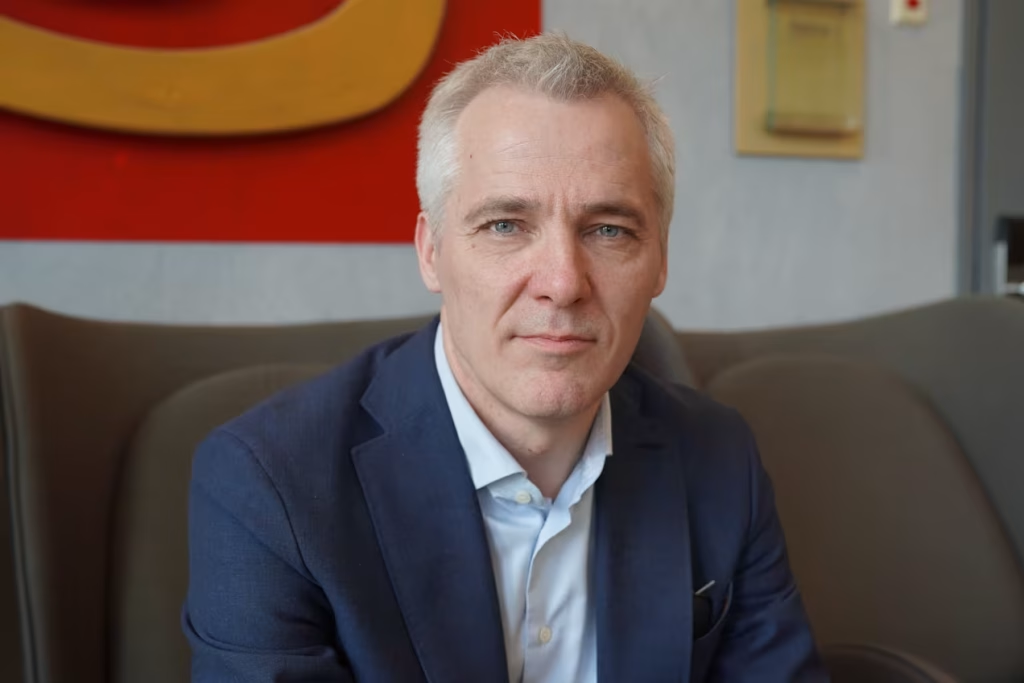
Anders Adlercreutz (SPP) has served as both Finland’s minister of education and the leader of the Swedish People’s Party for a little over a year. Image Credits: Jenna Emtö / Yle
The measures include additional weekly lessons in mathematics, native languages and literature for primary school pupils as well as expanded funding and adjustments to remedial education.
A new law approved last spring now restricts students’ use of personal mobile devices during lessons. From this month onward primary and secondary pupils may only use their phones in class with teacher approval for example to support learning or to handle health and safety-related matters.
Adlercreutz believes the combined reforms have the potential to improve education significantly though the effects will take time to show.
The latest Programme for International Student Assessment (PISA) results from two years ago revealed a drop in Finnish students’ performance in math, reading and science. This contrasts with Finland’s top-tier rankings in the early 2000s.
The added lessons in core subjects aim to give children more time to strengthen their foundational skills. Local school administrators will decide exactly how the extra hours are allocated.
The reforms also introduce a cap on how many students requiring special assistance can be assigned to a single teacher. The goal is to provide targeted support within the group without adjusting the whole class’s curriculum to the needs of a few pupils which is a practice that has sometimes left others missing out on essential learning.
In the future no more than five pupils in a teaching group may require a certain level of remedial support in one or more subjects. Around 100 million euros has been earmarked to fund this change with municipalities deciding how to distribute the funds.
According to Adlercreutz, this creates a clear obligation for municipalities to ensure adequate resources for student support. The rule will apply to preschool, primary, and upper secondary education starting this year, and to vocational schools from next year.
Also beginning next year Finland will offer an English-language secondary school option for students who are not proficient in either of the country’s official languages Finnish or Swedish.